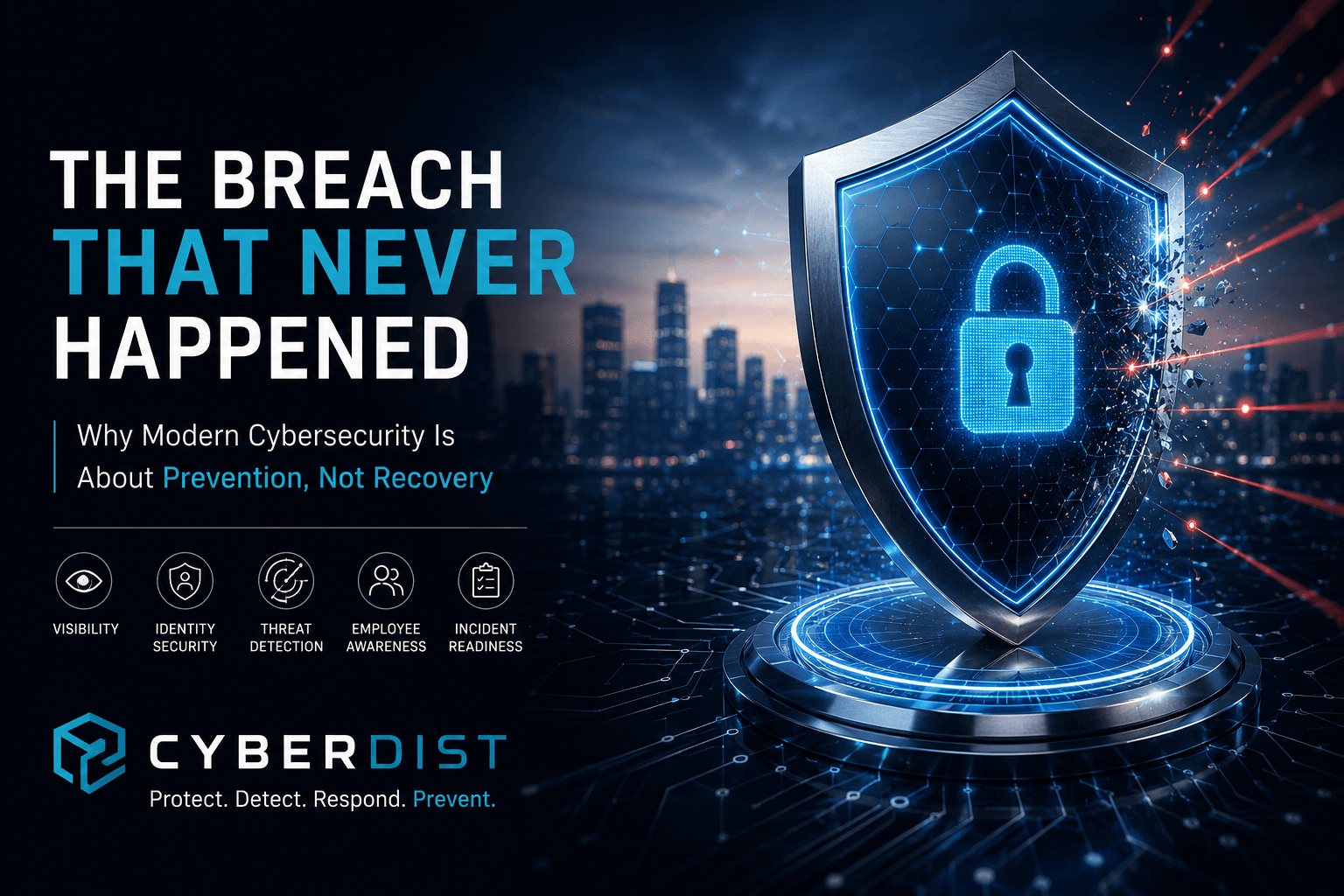
Most organizations still think about cybersecurity the same way they think about insurance: something you rely on after something goes wrong.
That mindset is costing businesses millions.
The most successful companies today aren't the ones that recover quickly from cyberattacks. They're the ones that prevent attacks from becoming incidents in the first place.
The New Reality of Cyber Threats
Cybercriminals have evolved. Gone are the days when attackers relied solely on obvious phishing emails filled with spelling mistakes and suspicious links.
Today's attacks are sophisticated, automated, and increasingly powered by artificial intelligence. Attackers can:
Create highly convincing phishing campaigns
Exploit vulnerabilities within hours of discovery
Target supply chains instead of direct victims
Use stolen credentials to bypass traditional security controls
For businesses, the question is no longer if someone will attempt to attack your systems.
The question is whether your defenses can detect and stop them before damage occurs.
Why Traditional Security Isn't Enough
Many organizations still depend on outdated security approaches:
✔ Antivirus software
✔ Basic firewalls
✔ Password policies
✔ Annual security audits
While these controls remain important, they are no longer sufficient on their own.
Modern cyber threats move too fast.
A single compromised account can lead to data theft, ransomware deployment, operational disruption, and reputational damage within minutes.
Security today requires continuous monitoring, intelligent detection, and proactive defense.
The Cost of Waiting
One of the biggest mistakes organizations make is treating cybersecurity as a future investment.
"We'll strengthen security next quarter."
"We'll conduct an assessment later this year."
"We haven't been attacked yet."
Unfortunately, attackers don't wait for budget cycles.
The financial impact of a cyber incident often extends far beyond technical recovery:
Lost revenue
Regulatory penalties
Customer trust erosion
Operational downtime
Legal costs
Brand reputation damage
In many cases, the cost of prevention is only a fraction of the cost of recovery.
Building Cyber Resilience
Effective cybersecurity isn't about buying more tools.
It's about building resilience.
Organizations should focus on:
Visibility
You can't protect what you can't see. Comprehensive asset discovery and monitoring are foundational.
Identity Security
Most breaches begin with compromised credentials. Strong authentication and access controls are essential.
Threat Detection
Early detection dramatically reduces risk. Organizations need real-time visibility into suspicious activity.
Employee Awareness
Technology alone cannot stop every threat. Employees remain one of the strongest lines of defense.
Incident Readiness
Even the best defenses can be tested. Having a well-defined response plan can make the difference between a minor event and a major crisis.
Security as a Business Enabler
One of the biggest misconceptions about cybersecurity is that it slows innovation.
The opposite is true.
Strong cybersecurity creates confidence.
It enables organizations to adopt cloud technologies, embrace digital transformation, serve customers securely, and expand into new markets without unnecessary risk.
In today's digital economy, cybersecurity is not merely an IT function.
It is a business function.
Final Thoughts
The strongest cybersecurity success stories rarely make headlines.
Why?
Because nothing happened.
No breach.
No ransomware.
No data loss.
No business disruption.
The goal of modern cybersecurity is not to create dramatic recovery stories. It's to ensure those stories never need to be told.
At CyberDist, we believe the best cyber incident is the one that never happens. Through proactive security strategies, continuous monitoring, and resilient defense frameworks, organizations can stay ahead of threats and focus on what matters most: growing their business with confidence.
CyberDist Insights Series - Empowering organizations with practical cybersecurity knowledge for a safer digital future.